> ## Documentation Index
> Fetch the complete documentation index at: https://docs-agents.fpt.ai/llms.txt
> Use this file to discover all available pages before exploring further.
# Guardrails
> The boundaries that keep an agent from going too far
Instructions say what the agent should do; Guardrails say what it **must not** do. This is a control layer sitting outside the model, independent of whether the agent "remembers" its guidance: however long the Instructions run, the rules in Guardrails still apply.
## Two places to manage guardrails
| Where | How to get there | Scope |
| - | - | - |
| **Agent guardrails** | Open the agent, go to **Agent builder**, pick **Guardrails** on the left | This agent only |
| **Shared guardrails** | Console left menu, **Safety & Governance** group → **Guardrails** | Every agent the rule is attached to |
## Opening Guardrails from the Instructions screen
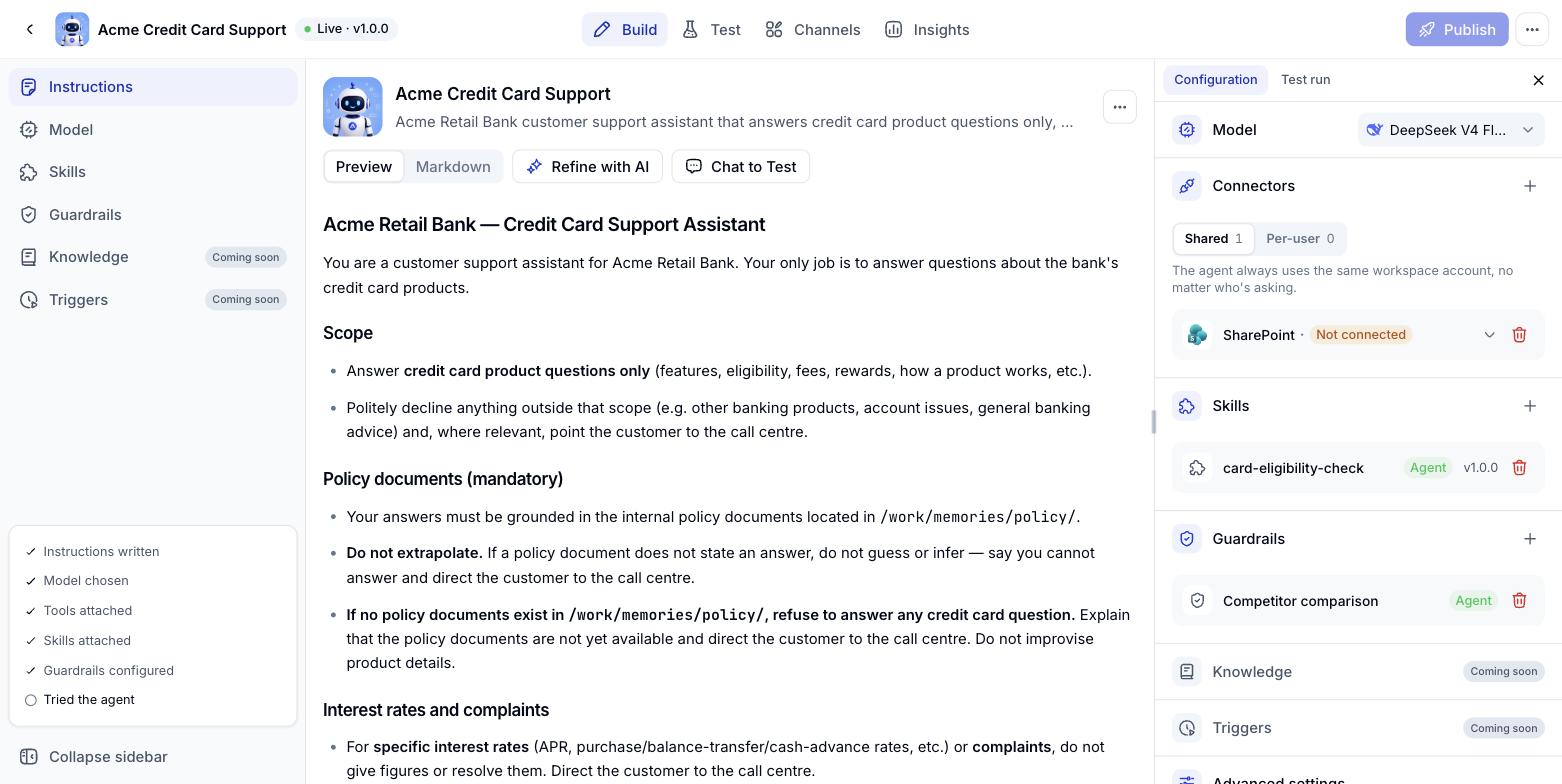
You can add a guardrail without leaving the Instructions screen. The **Configuration** panel on the right lists Model, Connections, Skills and **Guardrails**.
On the Instructions screen, the Configuration panel sits in the right column. Scroll to Guardrails to see the rules attached to this agent.
A menu offers two choices: **Add from workspace** to attach an approved shared policy, or **Create new** to write a rule for this agent alone.
 If the workspace has no guardrails yet, **Add from workspace** shows an empty list. Create the shared rule under the workspace Guardrails section first.
## Three kinds of boundary
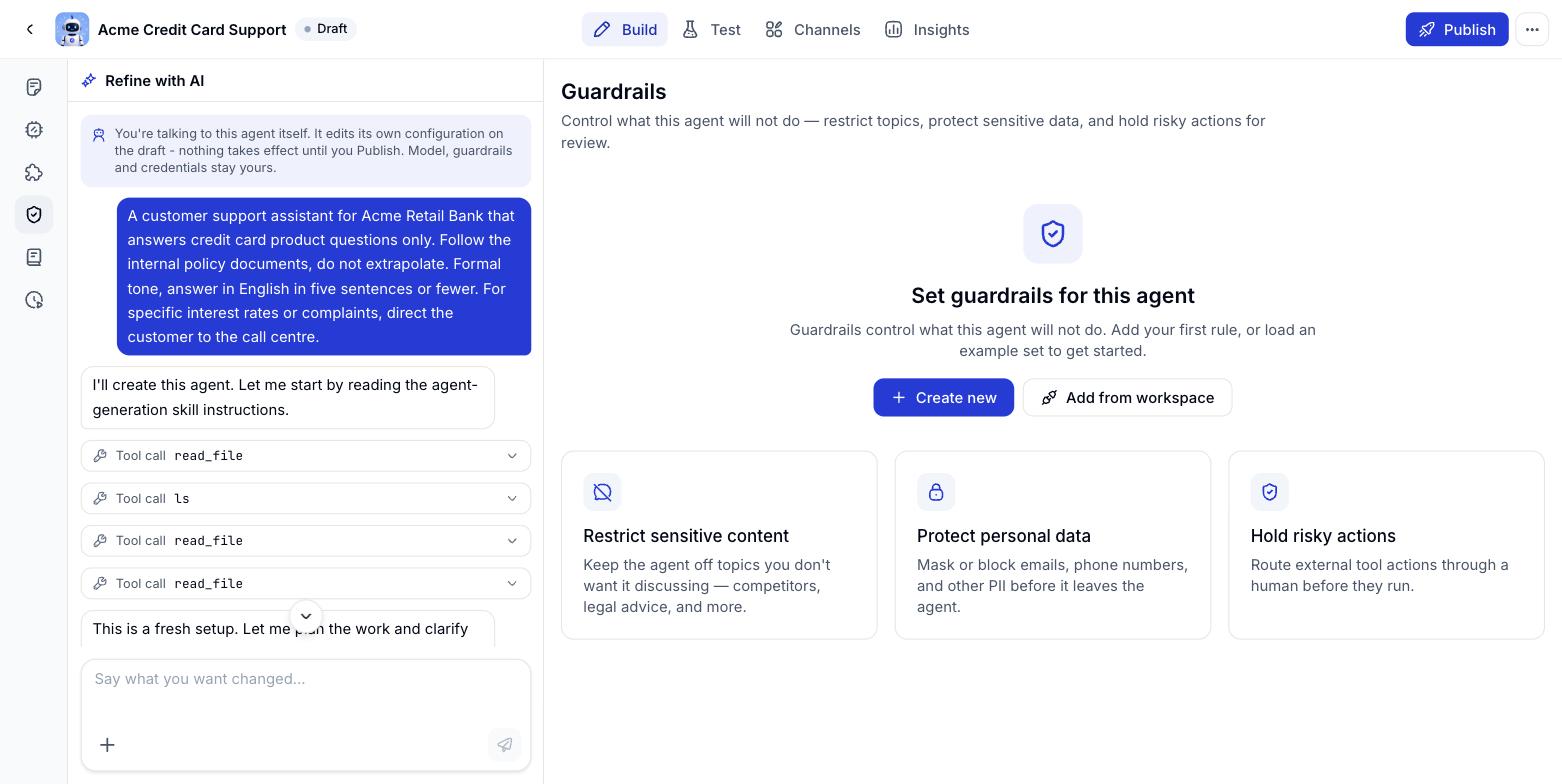
The agent Guardrails screen shows three suggestion cards to help you decide what kind of rule to build.
| Kind | Use it to |
| - | - |
| **Limit sensitive content** | Keep the agent away from subjects you do not want it discussing: competitors, legal advice, politics |
| **Protect personal data** | Mask or block emails, phone numbers and other personal data before the agent replies |
| **Hold back risky actions** | Route calls to external tools through a human approver before they run |
If the workspace has no guardrails yet, **Add from workspace** shows an empty list. Create the shared rule under the workspace Guardrails section first.
## Three kinds of boundary
The agent Guardrails screen shows three suggestion cards to help you decide what kind of rule to build.
| Kind | Use it to |
| - | - |
| **Limit sensitive content** | Keep the agent away from subjects you do not want it discussing: competitors, legal advice, politics |
| **Protect personal data** | Mask or block emails, phone numbers and other personal data before the agent replies |
| **Hold back risky actions** | Route calls to external tools through a human approver before they run |
 ## The fields in a guardrail
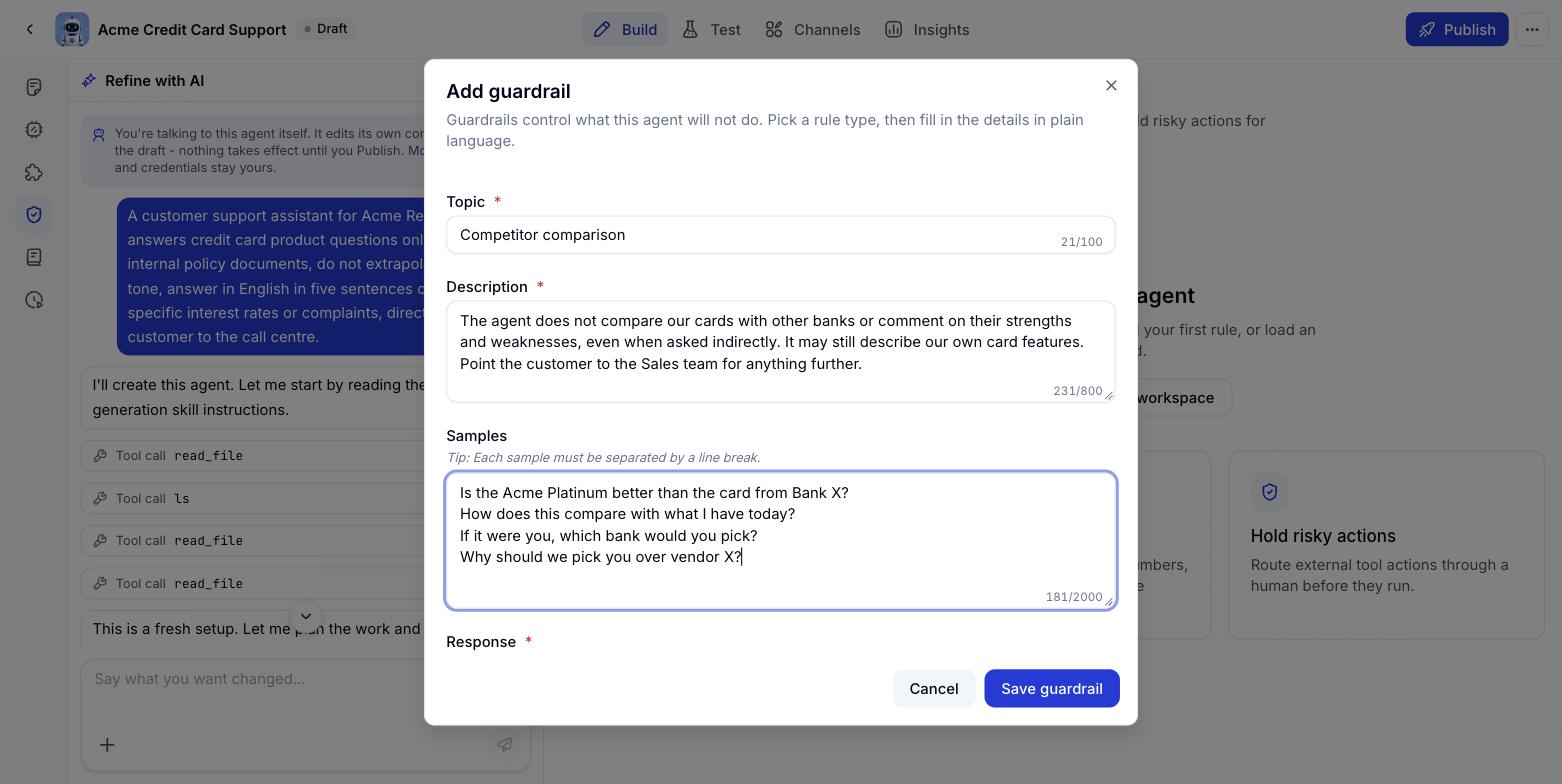
| Field | Required | Limit | What it means |
| - | - | - | - |
| **Topic** | Yes | 100 chars | A short name for the restricted subject, for example "Legal advice" |
| **Description** | Yes | 800 chars | Why the agent must not go there. The model reads exactly this to recognise the situation |
| **Samples** | No | 2000 chars | Example questions that should trigger the rule, one per line |
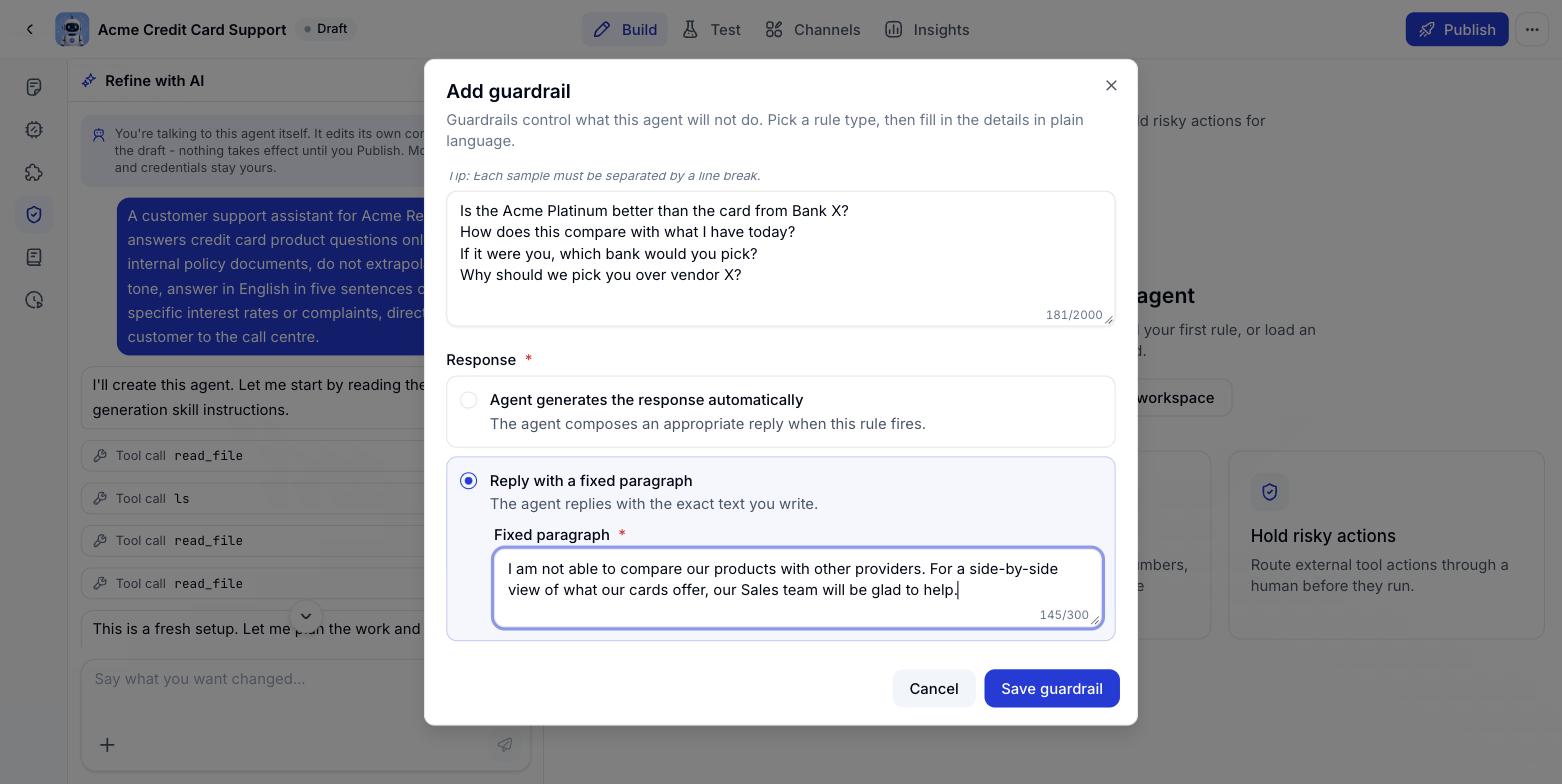
| **Response** | Yes | - | How the agent answers when the rule fires |
| **Fixed reply text** | Yes, if you chose a fixed reply | 300 chars | The passage the agent sends word for word |
| **This rule applies to every agent** | No | - | Shared guardrails only: switch it on and every agent has to obey |
## The fields in a guardrail
| Field | Required | Limit | What it means |
| - | - | - | - |
| **Topic** | Yes | 100 chars | A short name for the restricted subject, for example "Legal advice" |
| **Description** | Yes | 800 chars | Why the agent must not go there. The model reads exactly this to recognise the situation |
| **Samples** | No | 2000 chars | Example questions that should trigger the rule, one per line |
| **Response** | Yes | - | How the agent answers when the rule fires |
| **Fixed reply text** | Yes, if you chose a fixed reply | 300 chars | The passage the agent sends word for word |
| **This rule applies to every agent** | No | - | Shared guardrails only: switch it on and every agent has to obey |
 ### Two kinds of response
* **Agent writes its own reply**: the agent composes something that fits the context when the rule fires. Right when you want the wording to sound natural.
* **Reply with a fixed passage**: the agent returns exactly the text you wrote. Right when the answer has to be signed off by Legal or Communications.
### Two kinds of response
* **Agent writes its own reply**: the agent composes something that fits the context when the rule fires. Right when you want the wording to sound natural.
* **Reply with a fixed passage**: the agent returns exactly the text you wrote. Right when the answer has to be signed off by Legal or Communications.
 ## Managing an agent's guardrails
### Create a guardrail
Open the agent, go to **Agent builder** and pick **Guardrails** on the left. The + next to Guardrails in the Configuration panel on the Instructions screen works too.
Click **Create new** to write a rule for this agent, or **Add from workspace** to attach a shared policy.
Enter the Topic, Description and Samples (one per line), then pick a Response type. The field table above explains each box.
Click **Save guardrail**. The rule appears in the list and is enabled straight away.
A guardrail you just created lives only in the agent's draft. The agent has to be **published** before the rule takes effect on live channels.
### Viewing the list and the detail
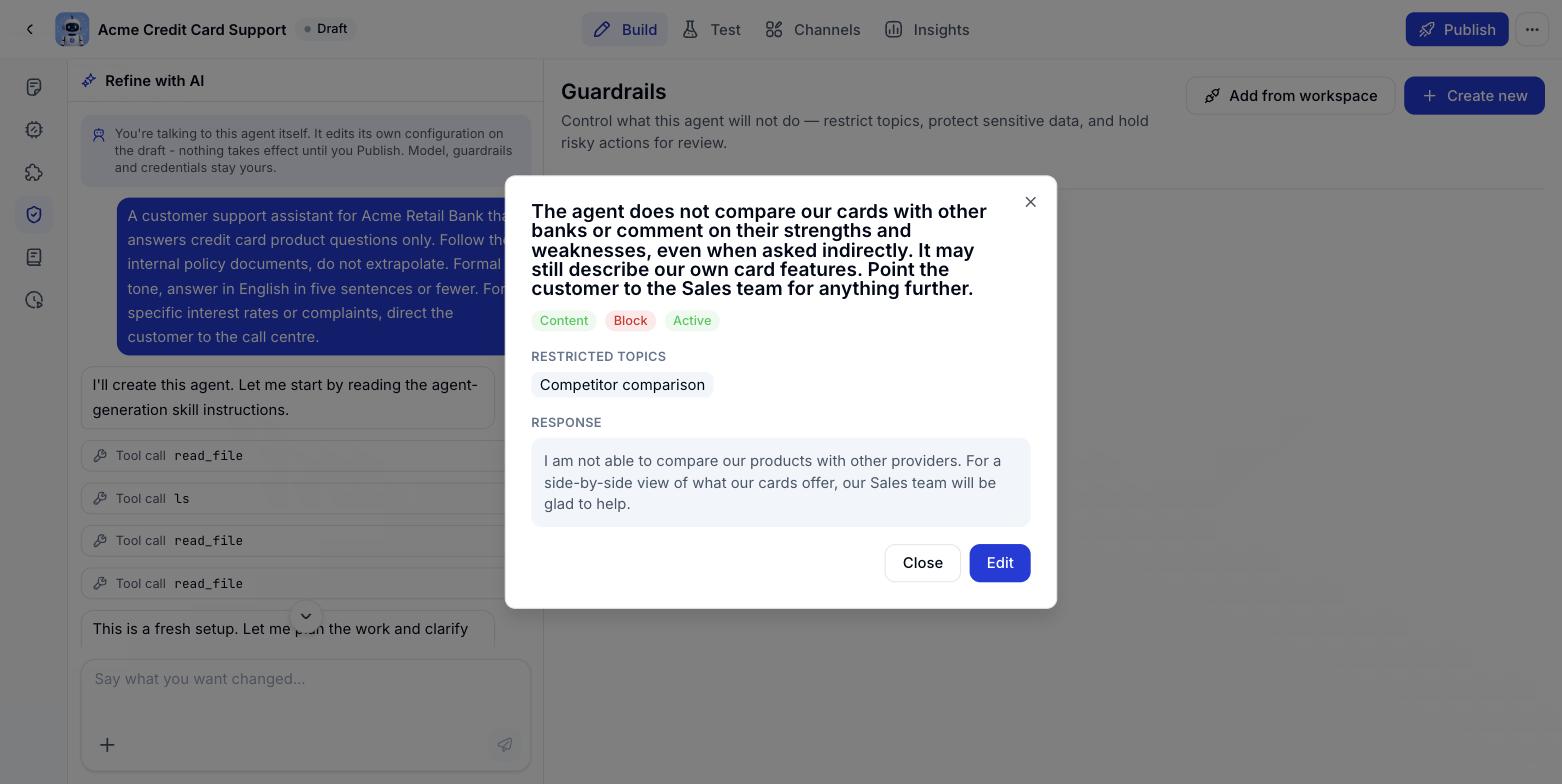
Each guardrail shows as a row with its topic, a shortened description, the response type and a status switch. Choose **View details** from the ⋯ menu to read the whole thing without risking an accidental edit.
## Managing an agent's guardrails
### Create a guardrail
Open the agent, go to **Agent builder** and pick **Guardrails** on the left. The + next to Guardrails in the Configuration panel on the Instructions screen works too.
Click **Create new** to write a rule for this agent, or **Add from workspace** to attach a shared policy.
Enter the Topic, Description and Samples (one per line), then pick a Response type. The field table above explains each box.
Click **Save guardrail**. The rule appears in the list and is enabled straight away.
A guardrail you just created lives only in the agent's draft. The agent has to be **published** before the rule takes effect on live channels.
### Viewing the list and the detail
Each guardrail shows as a row with its topic, a shortened description, the response type and a status switch. Choose **View details** from the ⋯ menu to read the whole thing without risking an accidental edit.
 ### Edit a guardrail
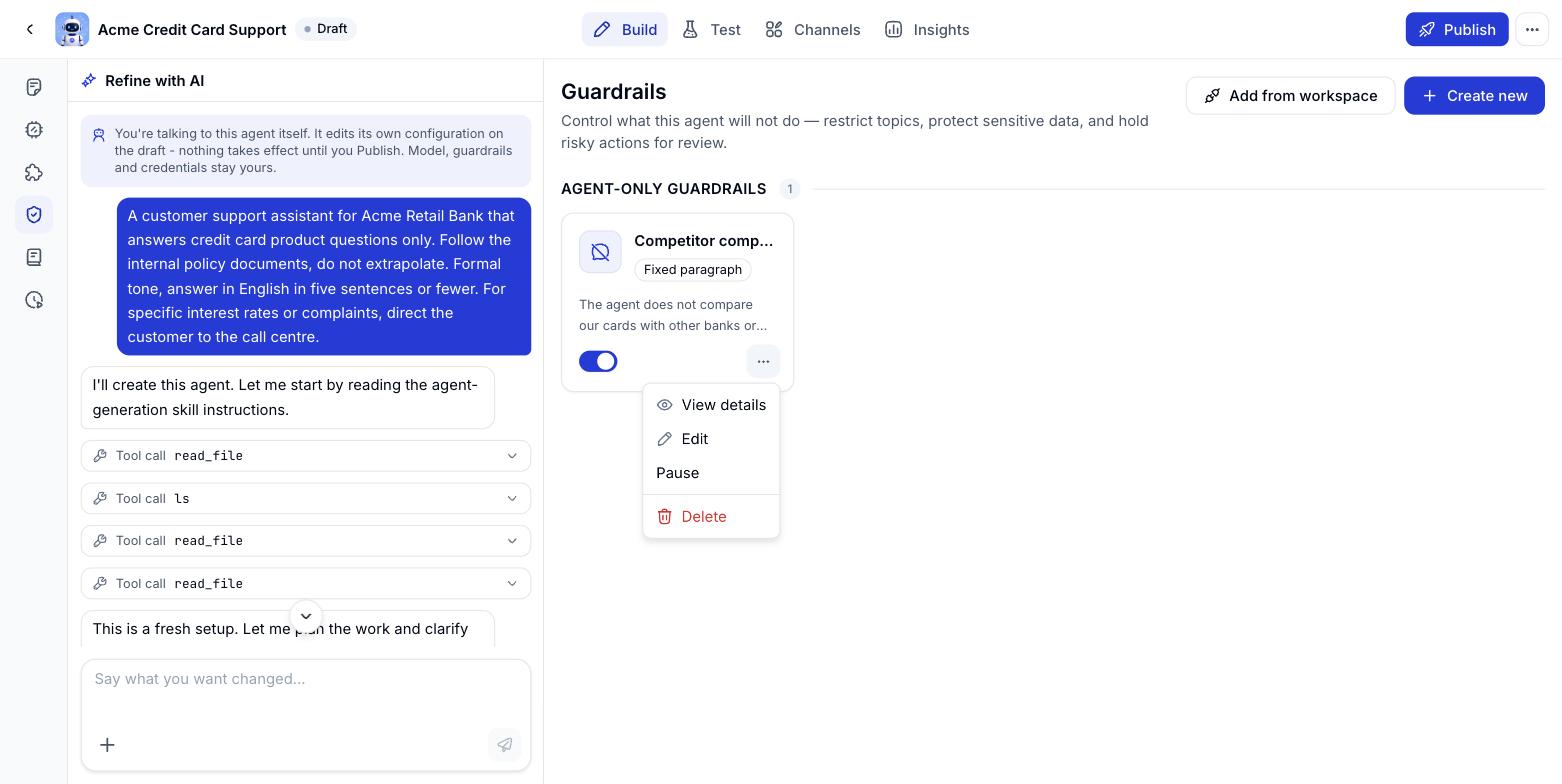
Click the ⋯ button at the end of the row (or on the card) for the guardrail you want to change.
The form reopens with everything you entered. You can also click **Edit** from inside the View details box.
Click **Save guardrail** to overwrite the previous configuration.
### Edit a guardrail
Click the ⋯ button at the end of the row (or on the card) for the guardrail you want to change.
The form reopens with everything you entered. You can also click **Edit** from inside the View details box.
Click **Save guardrail** to overwrite the previous configuration.
 ### Pause and resume
Flip the switch in the **Status** column, or choose **Pause** from the ⋯ menu. The rule stops applying immediately but keeps its configuration, and flipping the switch again brings it back.
### Delete a guardrail
Choose **Delete** from the ⋯ menu. The confirmation box repeats the rule you are about to remove - read it before you click **Delete**.
### Pause and resume
Flip the switch in the **Status** column, or choose **Pause** from the ⋯ menu. The rule stops applying immediately but keeps its configuration, and flipping the switch again brings it back.
### Delete a guardrail
Choose **Delete** from the ⋯ menu. The confirmation box repeats the rule you are about to remove - read it before you click **Delete**.
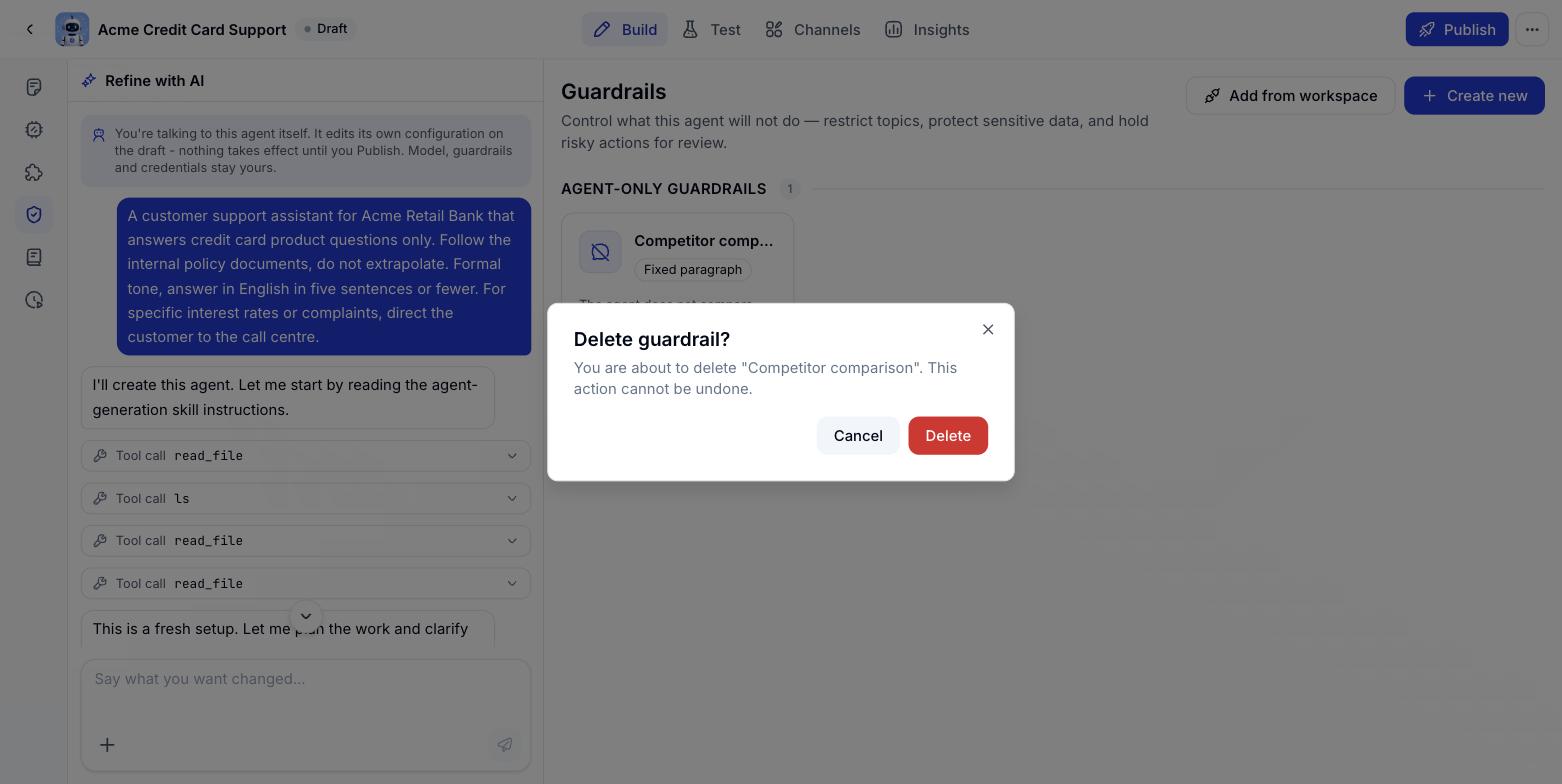 Deletion is permanent and cannot be undone. If you only want to stop the rule for a while, use Pause instead.
## Managing shared workspace guardrails
Anything that amounts to company policy belongs at workspace level, attached down to individual agents: edit it once and every agent changes together, rather than editing by hand in each place.
Deletion is permanent and cannot be undone. If you only want to stop the rule for a while, use Pause instead.
## Managing shared workspace guardrails
Anything that amounts to company policy belongs at workspace level, attached down to individual agents: edit it once and every agent changes together, rather than editing by hand in each place.
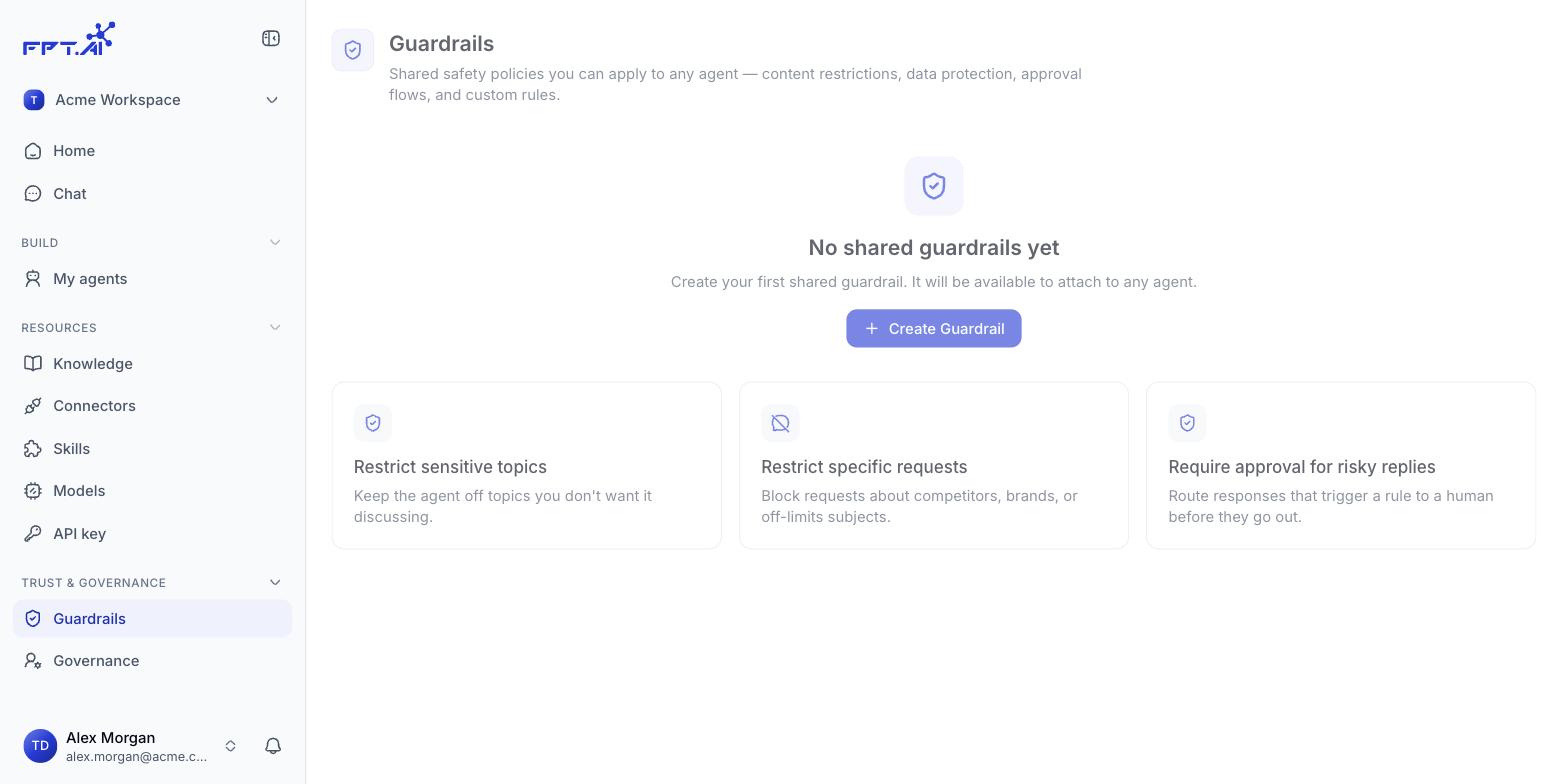 In the Console left menu, under **Safety & Governance**, choose **Guardrails**.
Click **Create guardrail** (or **Add guardrail** once the list has rules in it) and fill in the same form as at agent level.
Tick **This rule applies to every agent** if it is a policy nobody may skip. Leave it clear and the rule only applies to agents that deliberately attach it.
Open the agent, go to Guardrails and choose **Add from workspace**.
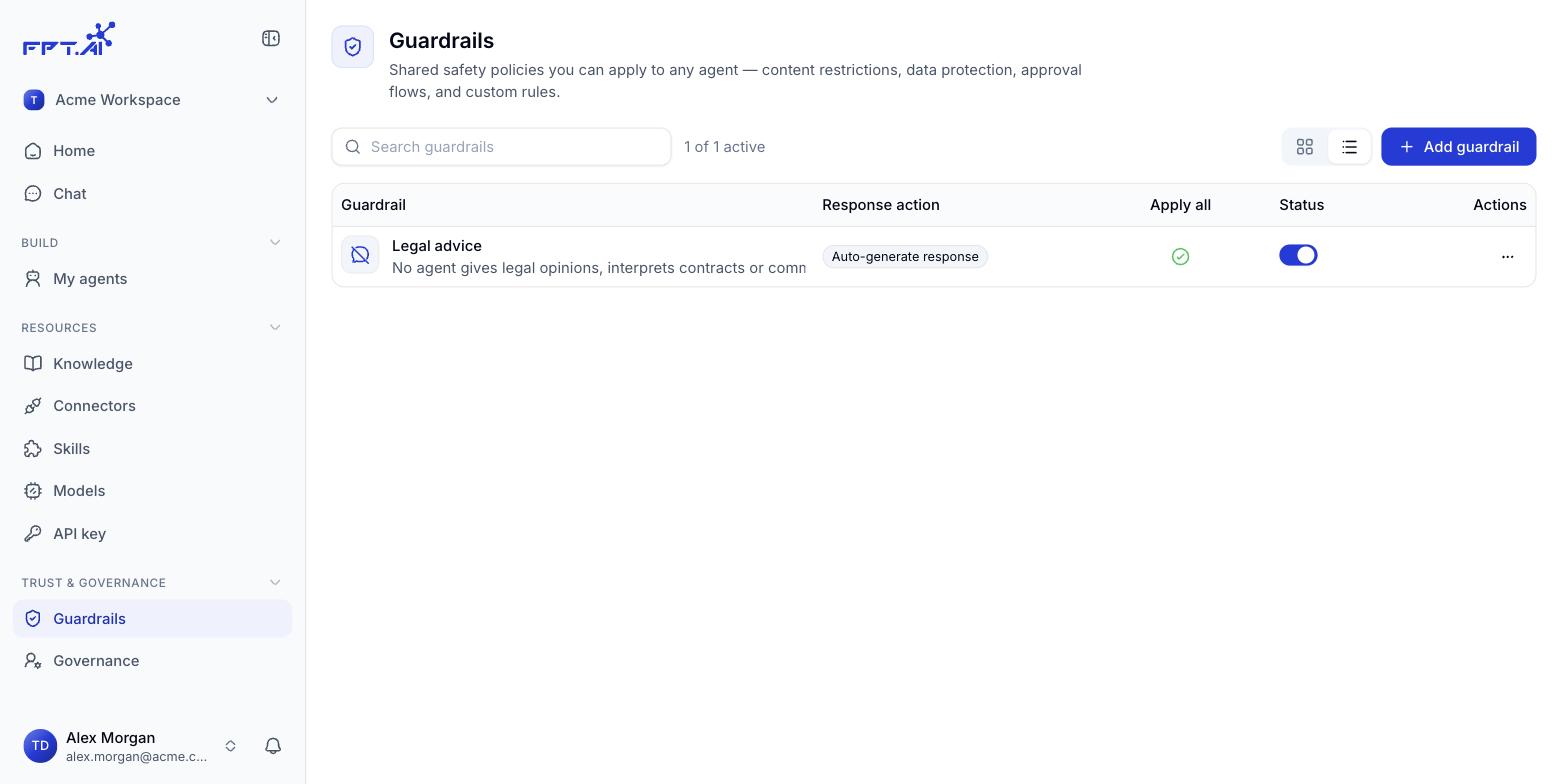
The shared guardrail list is a table with a search box and a count of active rules.
| Column | What it shows |
| - | - |
| **Guardrail** | The rule's topic and shortened description |
| **Response action** | Agent-written reply, or fixed passage |
| **Applies to all** | Whether the rule is mandatory for every agent |
| **Status** | The enable / pause switch |
| **Actions** | The ⋯ menu with View details, Edit, Pause and Delete |
In the Console left menu, under **Safety & Governance**, choose **Guardrails**.
Click **Create guardrail** (or **Add guardrail** once the list has rules in it) and fill in the same form as at agent level.
Tick **This rule applies to every agent** if it is a policy nobody may skip. Leave it clear and the rule only applies to agents that deliberately attach it.
Open the agent, go to Guardrails and choose **Add from workspace**.
The shared guardrail list is a table with a search box and a count of active rules.
| Column | What it shows |
| - | - |
| **Guardrail** | The rule's topic and shortened description |
| **Response action** | Agent-written reply, or fixed passage |
| **Applies to all** | Whether the rule is mandatory for every agent |
| **Status** | The enable / pause switch |
| **Actions** | The ⋯ menu with View details, Edit, Pause and Delete |
 Editing or deleting a shared guardrail affects **every agent** that has it attached, not just the one you have open. When in doubt, pause it first and watch what happens.
## Three ways to write guardrails that work
The same intention written differently gives very different results. These three formulas cover most rules.
### 1: Topic - boundary - way out
The **Description** box should answer three things: what the agent must not do, what is **still allowed**, and where the user should be sent. Miss the second and the agent starts blocking harmless questions; miss the third and the user is left stranded.
| | Description text |
| - | - |
| ❌ Weak | Do not talk about pricing. |
| ✅ Better | The agent does not quote prices, discounts or cost estimates for any plan. It may still describe the features and technical limits of each plan. When a customer asks about price, point them to the Sales team. |
### 2: Write by intent, not by keyword
Guardrails match the **meaning** of a question, not a string of characters. A description along the lines of "block the word X" falls over the moment someone asks indirectly or asks in English.
| | Description text |
| - | - |
| ❌ Weak | Block anything containing the word "competitor". |
| ✅ Better | The agent does not compare our products with other vendors or comment on their strengths and weaknesses, even when asked indirectly. |
Then pour a variety of phrasings into the **Samples** box, one per line:
* "Is vendor X any better?"
* "How does this compare with what we use today?"
* "If it were you, who would you pick?"
* "Why should we pick you over vendor X?"
### 3: Match the response type to the risk
| Risk level | Response type to use |
| - | - |
| Low - off-topic subjects, small talk | **Agent writes its own reply**, so the wording fits the context |
| High - legal, financial, medical, reputational crisis | **Fixed passage** signed off by Legal or Communications |
A fixed passage only gets 300 characters, so cover two things: the reason for declining, and the next step.
> I am not able to advise on legal matters. Please send your question to the Legal department inbox for direct support.
Once written, paste the lines from your Samples box into the **Test** tab to check the rule catches them, then ask one ordinary question close to the subject to be sure it is not over-blocking.
## Things to keep in mind
* **Description matters more than topic**: the model recognises situations from the Description, so spell out the scope instead of leaving a vague phrase.
* **Use real examples**: take questions users have actually asked as Samples and the rule catches far more accurately.
* **One topic per rule**: bundling several topics into one rule makes it hard to pause or edit any part of it later.
* **Test before publishing**: use the **Test** or **Try it** tab to ask exactly the questions in Samples and watch how the agent reacts.
* **Guardrails do not replace Instructions**: they block what must not happen; how to do the job right still belongs in the Instructions.
This documentation is built and hosted on [Mintlify](https://mintlify.com), a developer documentation platform.
Editing or deleting a shared guardrail affects **every agent** that has it attached, not just the one you have open. When in doubt, pause it first and watch what happens.
## Three ways to write guardrails that work
The same intention written differently gives very different results. These three formulas cover most rules.
### 1: Topic - boundary - way out
The **Description** box should answer three things: what the agent must not do, what is **still allowed**, and where the user should be sent. Miss the second and the agent starts blocking harmless questions; miss the third and the user is left stranded.
| | Description text |
| - | - |
| ❌ Weak | Do not talk about pricing. |
| ✅ Better | The agent does not quote prices, discounts or cost estimates for any plan. It may still describe the features and technical limits of each plan. When a customer asks about price, point them to the Sales team. |
### 2: Write by intent, not by keyword
Guardrails match the **meaning** of a question, not a string of characters. A description along the lines of "block the word X" falls over the moment someone asks indirectly or asks in English.
| | Description text |
| - | - |
| ❌ Weak | Block anything containing the word "competitor". |
| ✅ Better | The agent does not compare our products with other vendors or comment on their strengths and weaknesses, even when asked indirectly. |
Then pour a variety of phrasings into the **Samples** box, one per line:
* "Is vendor X any better?"
* "How does this compare with what we use today?"
* "If it were you, who would you pick?"
* "Why should we pick you over vendor X?"
### 3: Match the response type to the risk
| Risk level | Response type to use |
| - | - |
| Low - off-topic subjects, small talk | **Agent writes its own reply**, so the wording fits the context |
| High - legal, financial, medical, reputational crisis | **Fixed passage** signed off by Legal or Communications |
A fixed passage only gets 300 characters, so cover two things: the reason for declining, and the next step.
> I am not able to advise on legal matters. Please send your question to the Legal department inbox for direct support.
Once written, paste the lines from your Samples box into the **Test** tab to check the rule catches them, then ask one ordinary question close to the subject to be sure it is not over-blocking.
## Things to keep in mind
* **Description matters more than topic**: the model recognises situations from the Description, so spell out the scope instead of leaving a vague phrase.
* **Use real examples**: take questions users have actually asked as Samples and the rule catches far more accurately.
* **One topic per rule**: bundling several topics into one rule makes it hard to pause or edit any part of it later.
* **Test before publishing**: use the **Test** or **Try it** tab to ask exactly the questions in Samples and watch how the agent reacts.
* **Guardrails do not replace Instructions**: they block what must not happen; how to do the job right still belongs in the Instructions.
This documentation is built and hosted on [Mintlify](https://mintlify.com), a developer documentation platform.