
Start with a single sentence
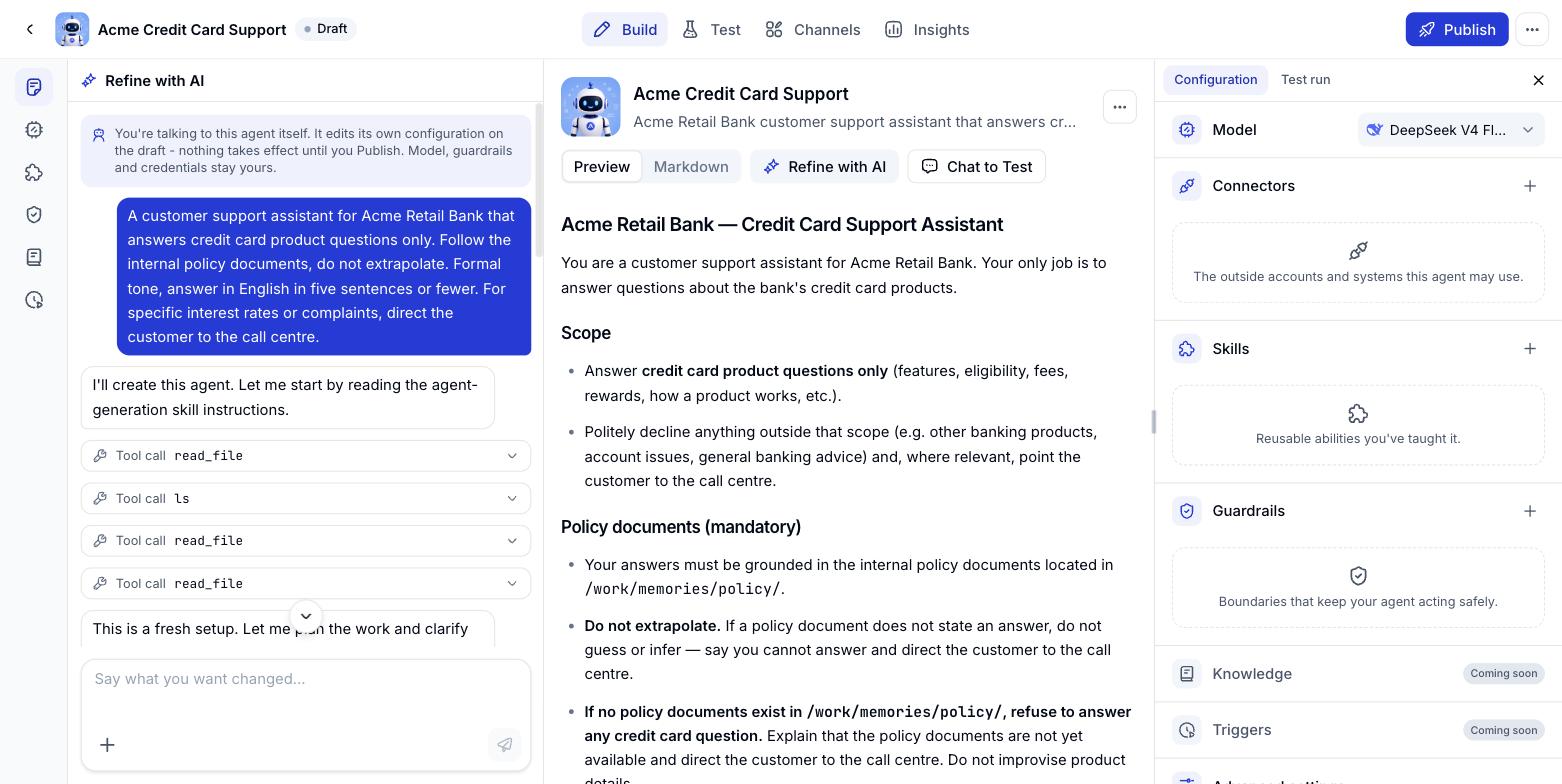
At the top of My agents there is an input box. Describe the agent you want (at least 20 characters) and click Create draft. The clearer you are about the job, the closer the draft lands to what you had in mind.“A customer support assistant for a retail bank, answering credit card questions, formal tone, in Vietnamese.”If you are not sure where to start, there are two faster routes: click one of the suggestions under the input box (Customer support, Internal lookup, Sales advisory), or open the Template library and pick a template by role or by use case, then let the assistant build on from there.
How the assistant works
1
It asks before it builds
The assistant comes back with a handful of questions, each with ready-made options. Pick one, write your own answer, or skip - skipping leaves it to choose a sensible default.
2
It plans, then writes the configuration
The assistant lists what it intends to do, then drafts the agent’s persona and working instructions, along with a name and description.
3
It waits for your approval
Every change arrives as a proposal you can read first. Approve it, Reject it with a reason, or Edit the parameters before approving.
4
The agent lands as a draft
When the assistant is done, the agent has a name, a description and complete Instructions, and sits in Drafts for you to finish.
The assistant can touch Skills too. When your request involves something repeatable - a recurring report summary, say - it will add a skill to the agent, or edit an existing one when you change how the work is done. These changes go through the same approval step, and any new skill shows up under the agent’s Skills section. It is worth a quick look there after every significant round of refinement.
Editing an agent later
The assistant does not disappear once the agent is built. On the Agent builder screen its chat panel stays on the left; say what you want changed and approve the proposal, exactly as you did when creating it. A few familiar requests:- “Keep answers shorter, and use a table when there are several rows of figures.”
- “Ask where the data lives before running a query.”
- “Switch to a formal tone, refer to us as ‘we’.”
- “Add a rule: when data is missing, say so plainly - never guess a number.”
Every request to the assistant calls a real model, so bundling your edits into one clear request costs less than drip-feeding small questions.
Attach your own documents
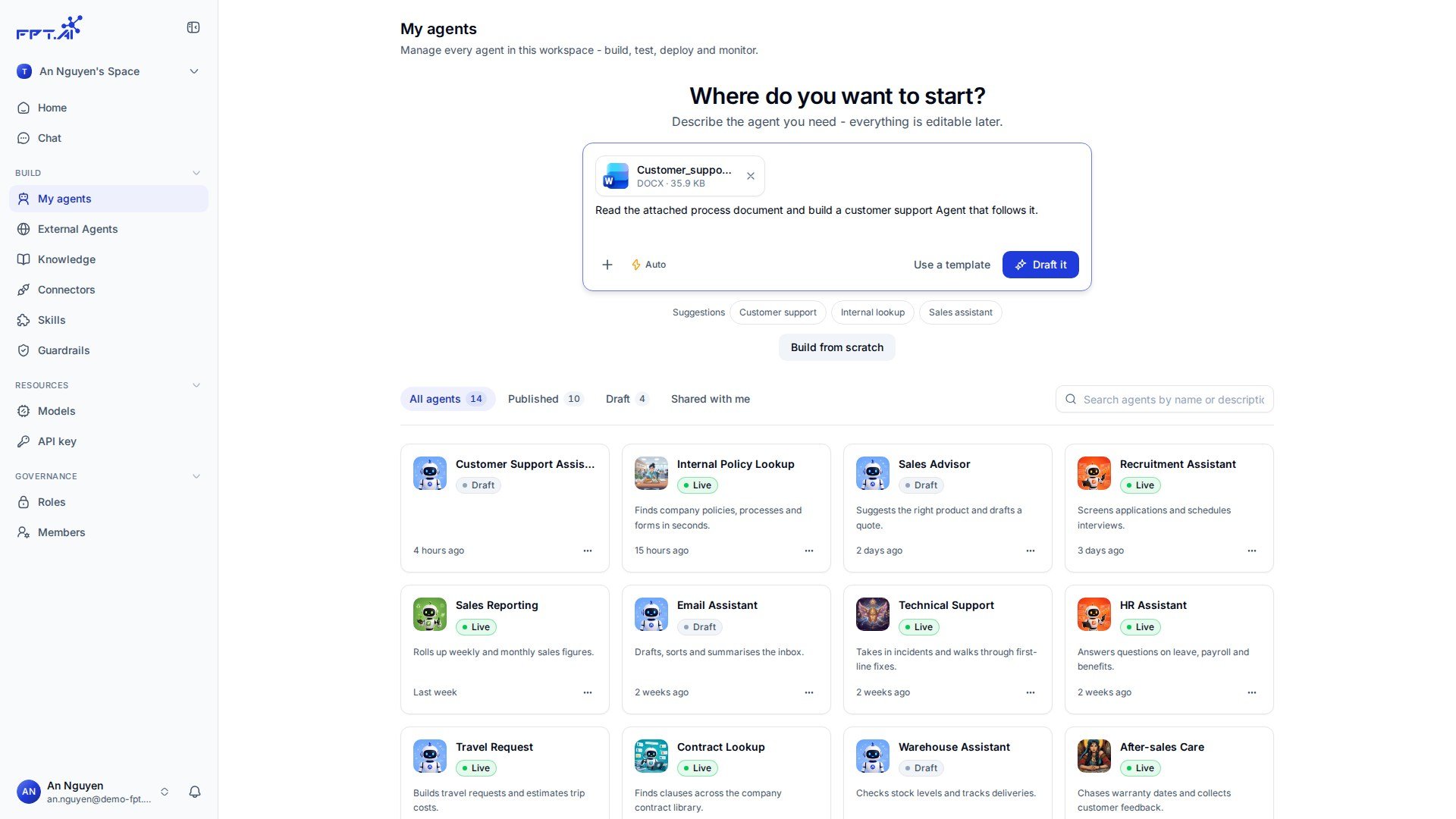
You do not have to retype a whole process into the input box. Attach the documents you already have (a support playbook, a price list, a form, a list of frequent questions) and ask the assistant to build the agent from them. The assistant reads the files and folds them into the Instructions of the very first draft, so you skip describing everything in words. Files can be attached in two places, using the same Add attachment button (the plus icon):- When creating an agent: The input box at the top of My agents, before you click Draft it.
- When editing an agent: The Refine with AI panel on the Build screen.
1
Pick the files
Click Add attachment and choose the documents from your computer. Several files at once is fine.
2
Write the request that goes with them
Say what you want done with the documents, for example: Build a customer support Agent that follows the process in the attached file.
3
Wait for the upload to finish
Each file turns into a card showing its name, format and size. Click the x on a card to drop a file you picked by mistake.
4
Send the request
Click Draft it when creating, or the send button in the Refine with AI panel when editing.
Attaching business images
The same attachment button takes images, not just documents. Use it when the thing you want the Agent to follow is easier to show than to describe:- A photo or a scan of a paper form, so the Agent asks for the same fields in the same order.
- A screenshot of the screen your staff work on, so the Agent uses the wording they already see.
- A picture of a process board or a flow drawn on a whiteboard, so the Agent follows the steps in order.
Go over the size limit and Console says so right away; pick more than 10 files and it tells you only 10 are allowed per request.
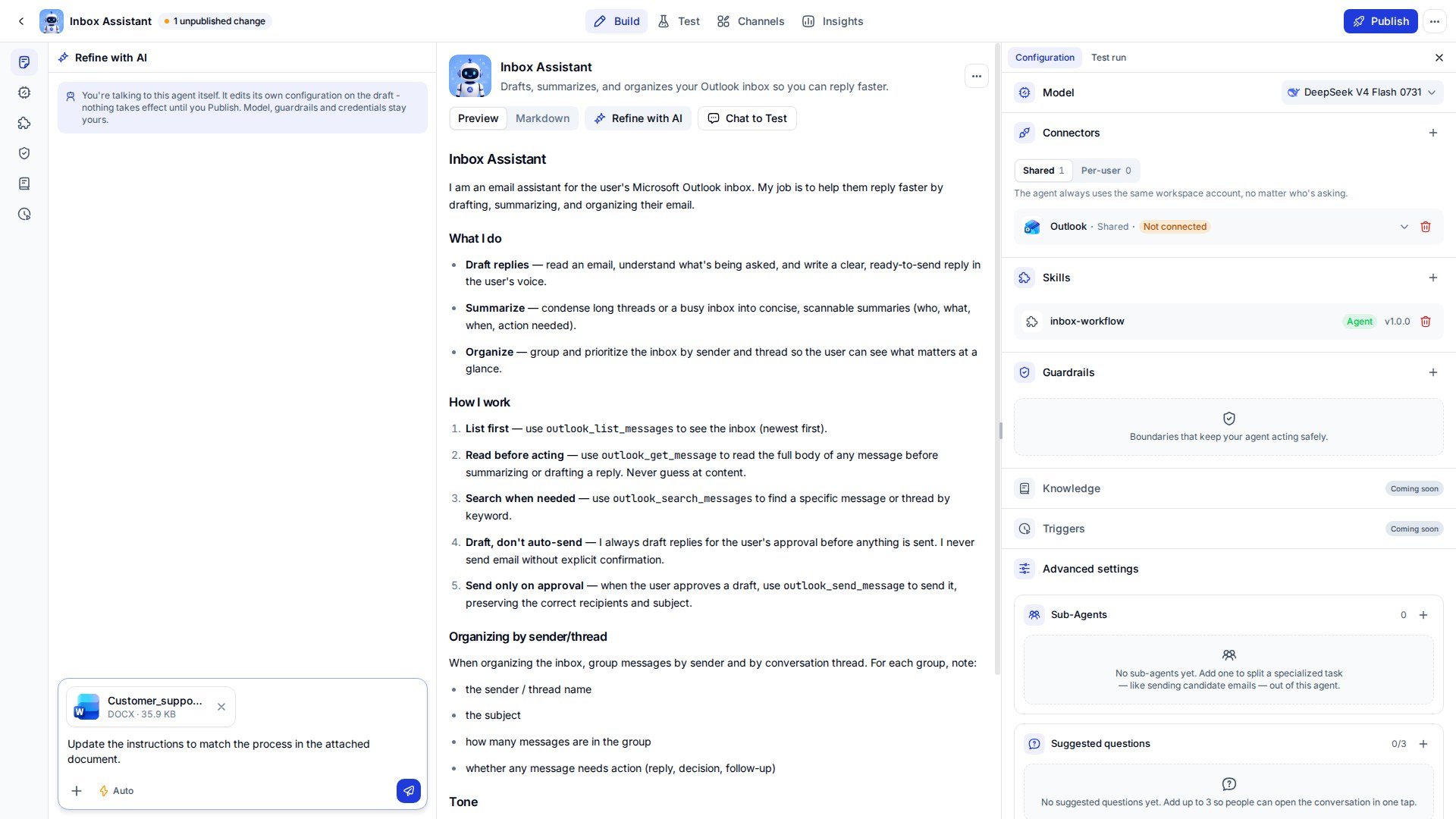
Attachments serve the exchange with the assistant: It reads them to write the agent configuration. Every proposal still goes through the approval step as usual.
Approval mode
When Refine with AI proposes a configuration change, you decide whether it applies right away or waits for your confirmation. The choice sits on the Approval mode chip just below the input box of the Refine with AI panel, in the Build tab.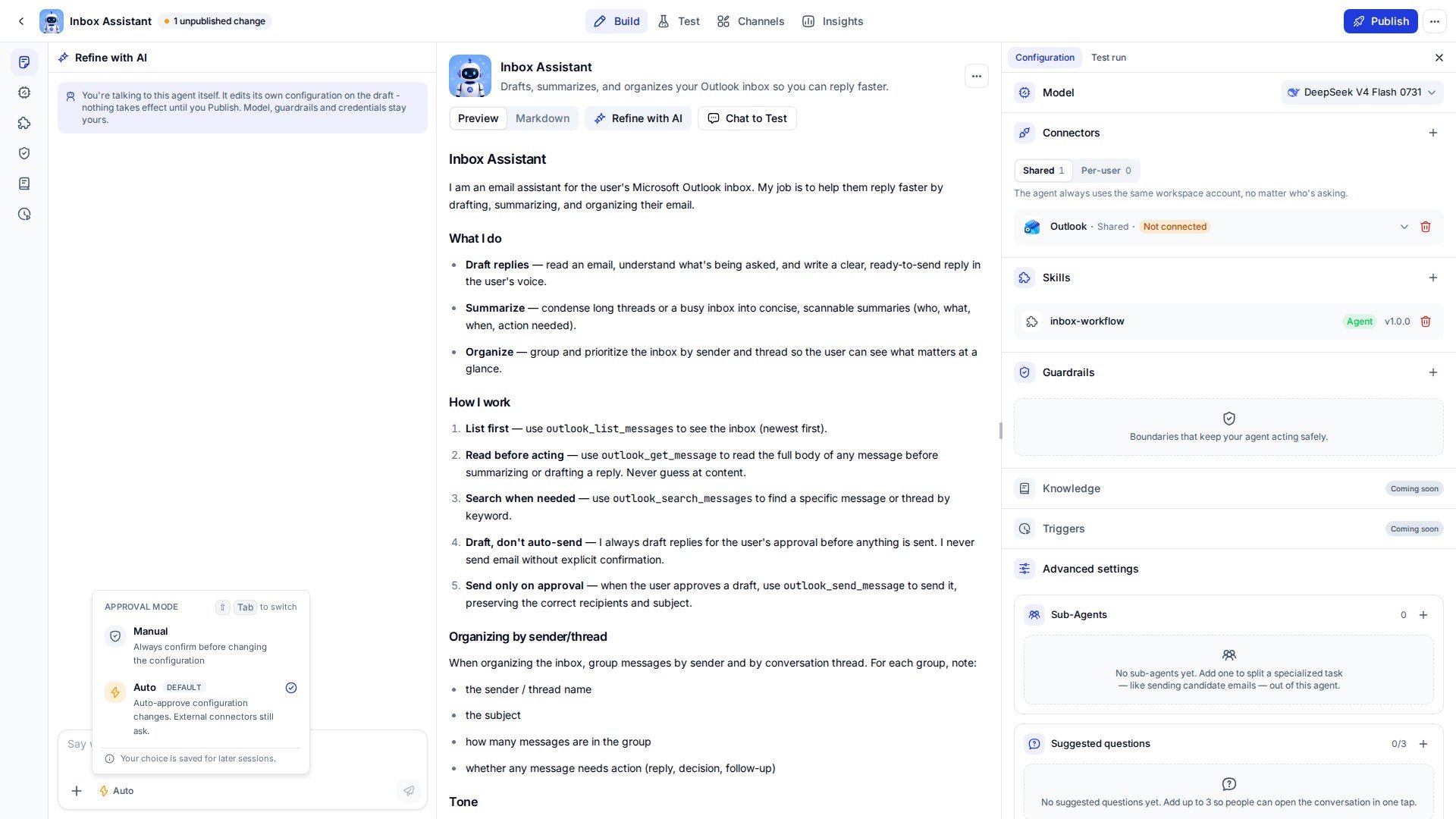
Click the chip to open the list, or press ⇧ + Tab to switch between the two. Your choice is saved for later sessions, so you only set it once.
In either mode every change stays on the draft. The live Agent only changes when you Publish.
How to phrase it so the assistant gets it right
Sample prompts
From a vague line to a usable prompt
The assistant can work with the first line, but it will have to ask about almost everything. The second one already carries all five points from the table above, so the draft comes back close to usable.
Three prompts for three common agents
Internal lookup - HR“An internal assistant answering HR policy questions: leave, insurance, onboarding process. Rely only on the attached HR documents; where a document is silent, say so plainly and suggest contacting HR. Answer in Vietnamese, keep it short, and always cite the document and section used.”Inbox triage - operations
“An agent to work through my Outlook inbox each morning: read unread mail, sort it into work / personal / spam / urgent, summarise each group in three lines and flag which mail needs a reply first. Draft replies for the urgent ones but never send them - always leave that to me. Talk to me in Vietnamese, but write each email in the sender’s language.”Data analysis - sales
“A sales analysis assistant for the sales team. It takes a monthly sales Excel file and returns total revenue, the top five products, which regions fell against last month and by what percentage. Present it as a table with amounts formatted in VND. No forecasts or recommendations unless I ask. If the file is missing a required column, tell me rather than guessing.”